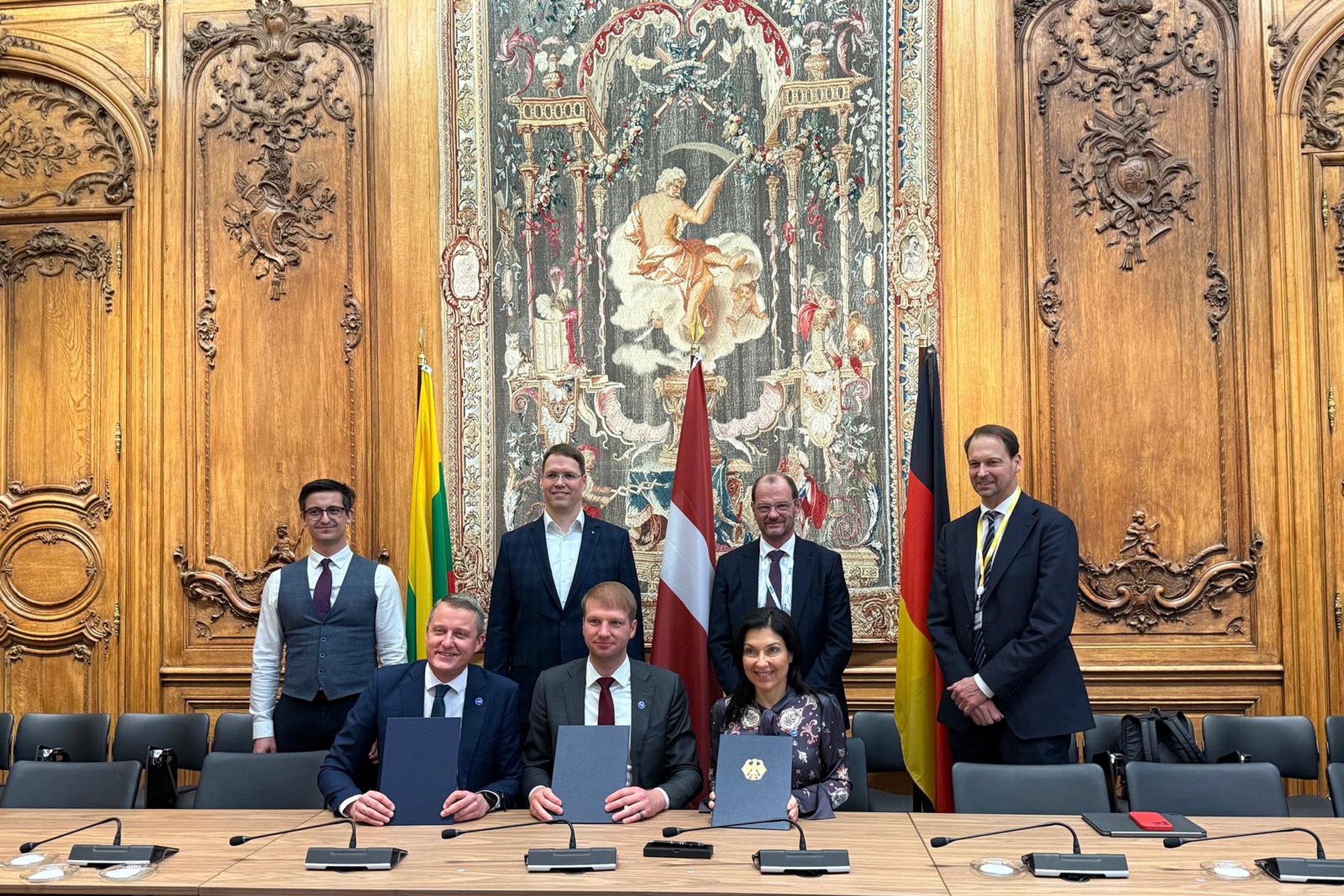
“Lithuania, Latvia, and Germany are cooperating intensively not only in the field of defense, but also in the field of energy. The possible new hybrid offshore interconnector project would significantly expand the electricity export opportunities of Lithuania and Latvia, creating the conditions for greater renewable energy development and energy security,” said Lithuanian Energy Minister Žygimantas Vaičiūnas.
Such a hybrid connection, Baltic-German PowerLink, would connect Germany and the Baltic countries via an electricity cable and would also allow for the development of renewable electricity generation capacities. The signed declaration of intent notes that the development of such hybrid electricity connections in the Baltic Sea region could provide multilateral benefits and create positive socio-economic effects for all participating countries. It would also help reduce dependence on fossil fuels and ensure competitive electricity prices.
It was agreed that Lithuania, Latvia, and Germany would continue to support studies carried out by transmission system operators and other institutions, including cost-benefit analyses, the development of financing models, and technical solutions.
Based on the results of the preliminary studies, consideration will be given to applying for the status of a Project of Common Interest in the European Union and to applying for EU funding for the implementation of detailed studies. There is also a possibility that other EU countries in the Baltic Sea region will join the project in the future.
Decisions on the next steps of the Baltic-German PowerLink project are planned to be made by the end of the third quarter of 2026.
Last spring, the electricity transmission operators of Lithuania, Latvia, and North-East Germany, Litgrid, Augstsprieguma tīkls, and 50Hertz, submitted a joint application for the inclusion of a hybrid offshore electricity interconnection, then known as the Baltic Hub, project into the 2026 Ten-Year Network Development Plan (TYNDP) of the European Network of Transmission System Operators for Electricity (ENTSO-E). During the preparation of the plan, a detailed EU-level project assessment will be carried out, analyzing the impact on the market and security of supply and creating the conditions for future EU funding.
The project concept previously presented by Litgrid, Augstsprieguma tīkls, and 50Hertz includes a 2 GW, approximately 600 km hybrid offshore connection, Baltic-German PowerLink. The connection point in the Baltic States is planned to be on the border between Lithuania and Latvia, with the exact location to be determined after technical studies. The possible completion date for the project is 2037.
The Baltic-German PowerLink project would enable electricity trading between the Baltic countries and Germany and would allow for the integration of up to 2 GW of offshore wind capacity in Lithuania and Latvia, as well as the expansion of onshore renewable energy capacity. This project would increase the reliability of electricity supply to all three countries.
Source: Lietuvos Respublikos energetikos ministerija