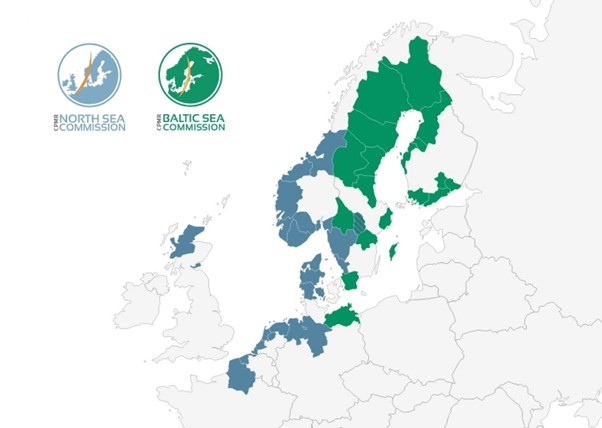
Regional leaders from across Northern Europe gathered on 28-29 January in Stockholm, Sweden, for a joint meeting and seminar of the CPMR Baltic Sea Commission and the CPMR North Sea Commission Executive Committees. Representing 47 regional authorities , the Executive Committees adopted a Political Declaration calling for Reinforced Regional Cooperation in Northern Europe to increase Competitiveness, Resilience, Sustainability, and Security.
Amid growing geopolitical tensions, hybrid threats and pressure on democratic institutions, this Political Declaration stressed the strategic importance of regional cooperation to strengthen Northern Europe’s contribution to boost Europe’s security, competitiveness and green transition. The CPMR Baltic Sea Commission and North Sea Commission Regions have a crucial role due to strategic transport corridors, ports as gateways of critical raw materials, clean energy resources, innovation capacity and smart coastal industries.
Read the joint Political Declaration.
Therefore, the CPMR Baltic Sea and North Sea Commissions haveagreed to intensify joint work on:
- Connectivity and infrastructure resilience, including dual‑use transport corridors, secure energy systems and protection of subsea infrastructures;
- Preparedness and democratic resilience, ensuring regions are fully involved in EU and national strategies;
- Critical infrastructure protection, with closer cooperation on hybrid and cyber threats;
- Marine ecosystem health, accelerating action to restore the Baltic and North Seas;
- A peaceful and sustainable Arctic, with strong support for Greenland and Indigenous communities;
- Joint advocacy, ensuring EU policies and funding – especially the next long-term EU budget and Interreg programme – reflect the needs of Northern regions.
Elisabet Babic (Region Halland, Sweden), President of the CPMR North Sea Commission, stated: “In a time of growing geopolitical tension, it is more important than ever that our regions maintain close cooperation with non‑EU partners, particularly Norway and the United Kingdom. It is vital that the entirety of Northern Europe work together to achieve resilience and stability. In this effort, the indispensable role of Norway and the United Kingdom – as major energy suppliers, NATO allies, and integral partners in European transport, maritime and security frameworks – must be fully recognised”.
In In a seminar addressing “Regions in Action: Building Security and Resilience Across Northern Europe”, representatives from the Council of the Baltic Sea States, the European Commission and the Parliament of Sweden highlighted the importance to strengthen complementarity and cooperation between the levels of governance to build resilience and security. The CPMR Baltic Sea and North Sea Commissions emphasised that Northern Europe’s regions are essential to Europe’s long‑term security, energy transition and sustainable growth, and called on EU and national governments to give the region the strategic attention it requires.
Commenting on that, Vice-President of the CPMR Baltic Sea Commission, Rickard Carstedt (Region Västerbotten, Sweden) stressed: “As hybrid threats and pressure on democratic institutions in Northern Europe especially in the Arctic are rising, closer cooperation between our North Sea and Baltic Sea regions is essential to build long-term security and resilient communities and businesses. Regions are strategic actors in delivering Europe’s green transition, competitiveness and security. United, the BSC and NSC are calling for more Northern Europe perspectives in the EU, and more EU in the Northern part of Europe!”.
In the weeks ahead, the CPMR Baltic Sea Commission and the CPMR North Sea Commission will further strengthen their cooperation on Northern Europe’s security landscape, including through a joint meeting in February hosted by Region Örebro and the adoption a Joint Statement on Transport Policy entitled “Towards a more connected, resilient and secure northern Europe”, calling for sufficient EU support to improve transport connections and infrastructures in Northern Europe for a dual use purpose.
Source: EUSBSR