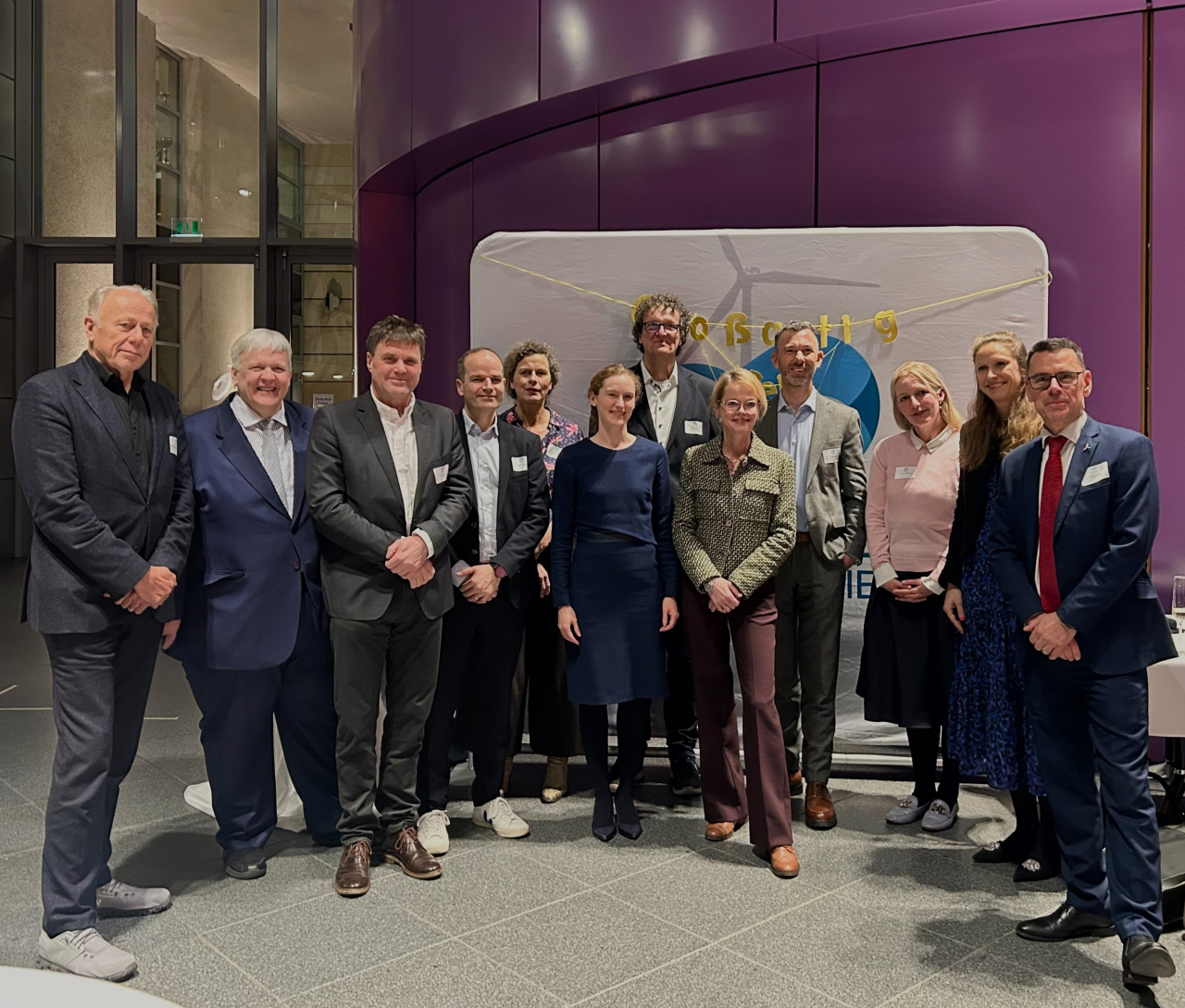
Berlin, 27 November 2025 – The OFFSHORE WIND ENERGY Foundation (Stiftung OFFSHORE-WINDENERGIE) celebrated its 20th anniversary with a ceremony at the British Embassy in Berlin. On Tuesday, high-ranking representatives from politics, science and business in Germany and the United Kingdom discussed milestones achieved, current developments and the key challenges for the coming decade.
Keynote speaker Jürgen Trittin, under whose leadership the Federal Environment Ministry founded the foundation in 2005, praised the foundation’s continuous work as a reliable voice for offshore wind energy and its contribution to the success story of the energy transition at sea: “In 20 years, offshore wind energy has developed from an expensive niche technology into a global, competitive key industry. Offshore is a pillar of climate protection and employs 50,000 people in Germany. Venturing more offshore is good for the climate, industry, jobs and Europe’s resilience.”
Since 2005, the OFFSHORE WIND ENERGY Foundation has been shaping the expansion of offshore wind energy as an independent catalyst and platform for exchange between diverse stakeholder groups. With the development and support of the alpha ventus test field, the continuous advancement of technical and economic standards, and ongoing work on acceptance and political framework conditions, the foundation has set a key course and played a decisive role in shaping offshore wind energy in Germany.
In addition to the milestones achieved, the current considerable structural and market challenges facing the industry were also discussed. Martin Gerhardt, Head of Offshore Product Management at Siemens Gamesa and member of the board of the OFFSHORE-WINDENERGIE foundation, warned: ‘If offshore wind energy is to fulfil its role in the energy transition, we must act now: the 17 GW of projects that are still awaiting a final investment decision need functioning PPA markets and political support. For future projects, the introduction of CfDs (contracts for difference) as a proven instrument is crucial.’
A look at neighbouring European countries shows that the German market is not alone in facing these challenges – and yet the search for solutions is already more advanced elsewhere. The United Kingdom, for example, has already gained years of experience in optimising its investment framework, as Kathryn Boyd, Deputy Trade Representative for Europe and Director of Trade in Germany, emphasised in her welcoming address. In Germany, too, the industry’s demands seem to be being taken seriously. In the upcoming amendment to the Offshore Wind Energy Act, the Federal Ministry for Economic Affairs and Energy is striving to achieve the necessary planning and investment security.
Chairwoman Dr Ursula Prall looks to the future with determination: “In the coming years, the OFFSHORE-WINDENERGIE Foundation will continue to be a strong voice for the reliable and forward-looking expansion of offshore wind energy. We will continue to advocate for an expansion-friendly tender design, stable framework conditions for maintaining diversity among stakeholders, and close cooperation between all stakeholders – nationally, across Europe and internationally. In this way, offshore wind energy will remain a driver of innovation, a guarantor of security of supply and a catalyst for a climate-neutral industrial society in the future.”
About the OFFSHORE WIND ENERGY Foundation
The OFFSHORE WIND ENERGY Foundation was established in 2005 to promote environmental and climate protection through improved research and development of offshore wind energy. It has established itself as a non-partisan, supra-regional and cross-sector think tank for the development of offshore wind energy in Germany and Europe. The foundation is a communication platform for stakeholders from politics, business and research, serves as a forum for knowledge exchange and sees itself as a source of ideas and a multiplier. The foundation’s board of trustees includes representatives from key federal and state ministries responsible for offshore wind energy, as well as operators, manufacturers, transmission system operators, suppliers, banks and insurance companies.
Source: Stiftung OFFSHORE-WINDENERGIE