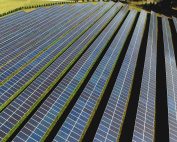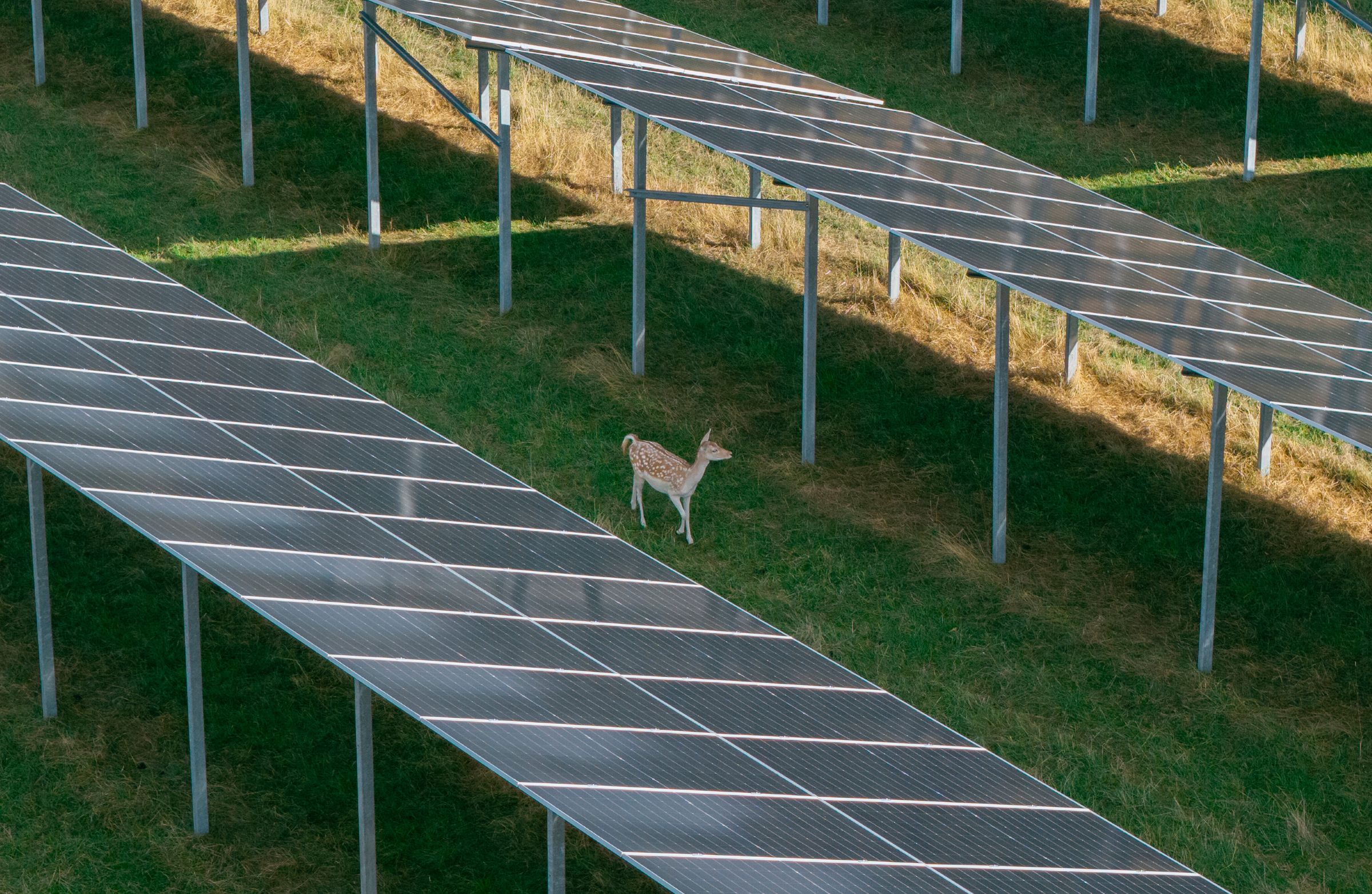
Perigus Energy has commissioned an 8.3 MWp ground-mounted solar park built inside a working fallow deer enclosure at the Weiherhof farm in Sötern, in the municipality of Nohfelden, Saarland. The plant was formally inaugurated on 1 September 2026 and is, according to the developer, the first large-scale ground-mounted array in Germany to share a deer enclosure with the animals that graze it.
The array covers 6.9 hectares of the enclosure and is expected to generate around 9.5 million kilowatt-hours a year, equivalent to the consumption of roughly 3,200 households and about 5,530 tonnes of CO2 avoided annually. Perigus Energy built the plant and will operate it long term.
The engineering is what makes the dual use work. Modules are elevated on an agri-PV frame with a ground clearance of 1.60 to 1.80 metres, leaving the herd room to move underneath and between the rows while providing shade in heat and shelter in poor weather. Partial shading is also expected to stabilise pasture yields through dry summers. A dedicated wildlife fence and adapted protection concepts for cable routing and inverters were installed for the animals.
The herd of roughly 150 animals grazed on alternative land during the nine-month construction period and returned once work finished at the end of July. “The first experiences are extremely positive. The animals are taking well to the redesigned areas and move naturally under and between the module rows,” said Wolfgang Welter, owner and operator of the Weiherhof. “We will continue to follow the development closely and keep observing and documenting the animals’ behaviour.”
Saarland environment, climate, mobility, agriculture and consumer protection minister Petra Berg attended the opening and called the plant a milestone for the state, saying the Welter family’s farm shows how sustainable and forward-looking agriculture can work. Annemarie Röbl, head of project management at Perigus Energy Deutschland, said the animals’ needs were weighed alongside generation requirements from the start. The municipality of Nohfelden receives 0.2 cents per kilowatt-hour fed in, under the municipal bonus in paragraph 6 of Germany’s Renewable Energy Sources Act.
The relevance beyond Saarland is the land-use argument. Competition between solar and farmland is a live political problem in Poland and the Baltic states, where ground-mounted projects regularly meet the objection that they take productive land out of use. A commissioned plant that keeps 150 animals grazing underneath is a harder case to argue against than a fenced-off field, and Perigus says the operating experience will feed into further WildparkPV projects. The company, formerly OSTWIND and then Ørsted’s German onshore business, is now part of Copenhagen Infrastructure Partners and operates 668 MW of renewables in Europe, with more than 160 MW under construction.