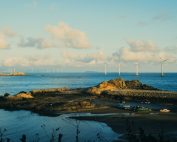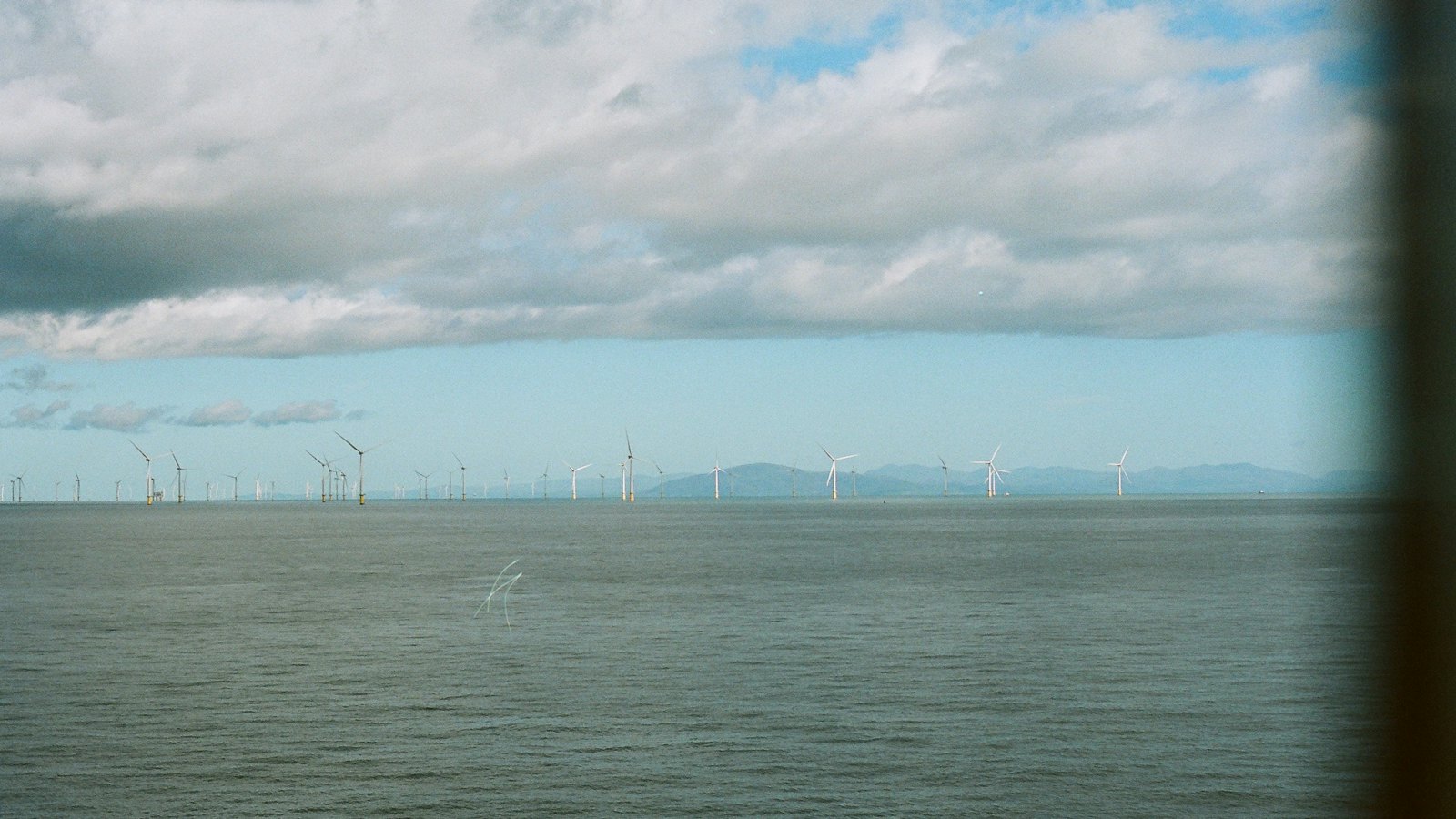
Poland and Germany already have turbines standing in the Baltic. Estonia and Latvia have something less visible: a year of buoy data, a three-year design contract, a seal survey and a new energy strategy. This backgrounder tracks the two projects that will decide whether the eastern Baltic gets its own offshore wind, the state-run Estonian-Latvian ELWIND project and Enefit’s Liivi project in the Gulf of Riga, and sets out what still separates them from construction.
The policy frame: a market-based target, with a safety net
The Estonian government’s energy development plan to 2035, known as ENMAK 2035 and approved in January 2026, is the document both projects will be judged against. It keeps the ambition of 100 per cent renewable electricity consumption, but only “on a market-based basis” once generation technologies are competitive without operating subsidies, which the ministry expects in the 2030s. It also states plainly that most of the country’s oil-shale capacity is “old, unreliable and not competitive”, and it leaves the door open to nuclear.
“Market-based development yields the best results; however, should market forces fail to deliver the desired outcomes, we have solutions in reserve, such as measures to ensure dispatchable capacity, financial instruments, or the reduction of bureaucracy,” said Andres Sutt, Estonia’s Minister of Energy and Environment, when the plan was adopted. For offshore developers that sentence cuts both ways: no promise of a support scheme, but a stated willingness to intervene if the market does not deliver.
ELWIND: design work is now under contract
ELWIND is the joint Estonian-Latvian state project for two offshore wind farms in the two countries’ waters, run on the Latvian side by the Investment and Development Agency of Latvia. In February 2026 the agency signed Haskoning for the design phase, a three-year assignment covering the Pre-FEED study, the conceptual design and the technical design. Haskoning’s scope includes layout optimisation, transmission grid studies and the integration of site investigations and environmental assessments into a single technical basis; Empire Engineering is subcontracted for the turbine foundations. Haskoning had already carried out the project’s cable study in an earlier phase.
The Pre-FEED stage is where the project’s real shape gets fixed. According to ELWIND, it will define the scope of the wind farms, update the technical basis, assess site conditions and evaluate the grid connection options. The technical design phase then folds in the results of the grid connection pre-study, the environmental impact assessment and the site data into one report, which is the document a future investor or auction would work from.
The environmental baseline is being built in parallel
Also in February 2026, ELWIND contracted 3Bird OÜ for a marine mammal study across the development areas. The work maps the abundance, distribution and year-round use of the sites by grey seals, ringed seals and, where present, harbour porpoises, and assesses installation noise, cross-border effects and the cumulative impact of other regional projects. It follows a bat monitoring campaign run from May to September 2025 in both countries’ waters, serviced out of the port of Ventspils with local vessels, whose results are already feeding into the environmental impact assessment.
Liivi: Enefit now has a year of measured wind
Enefit’s Liivi project in Liivi Bay is at a different stage of the same journey. The Fraunhofer Institute for Wind Energy Systems IWES ran a site condition campaign there from October 2024 to December 2025, using a floating lidar buoy with co-deployed oceanographic sensors to record wind profiles, turbulence intensity, waves and currents. The buoy was lifted out for the sea-ice season, a constraint Baltic developers further south rarely face, and an onshore lidar on Kihnu Island plus flow modelling bridged the gap. The Estonian State Fleet supported the campaign at sea.
“Liivi Bay represents a strategically important location for the development of offshore in the Baltic region,” said Johann-Gustav Lend, Baltics Business Development Manager at Enefit, when the campaign closed. A full year of bankable wind data is the point at which a project stops being a line on a marine spatial plan and starts being something a lender can price.
Why the timing matters
The domestic market the projects would serve is changing fast. Estonia’s greenhouse gas emissions fell to 12 million tonnes of CO₂ equivalent in 2024, down 66.5 per cent on 1990, according to the Ministry of Climate’s inventory. Fossil generation dropped from 2,302 GWh to 1,963 GWh in a year while renewable output rose from 2,607 GWh to 3,398 GWh, and the ministry linked the shift to a 4 per cent fall in the average market price. In Latvia, state-owned Latvenergo invested a record €792 million in 2025, most of it in wind and solar, and now holds an approved renewable pipeline of 1,144 MW and a 24 per cent share of all Baltic generation. None of that pipeline is offshore, which is the gap ELWIND and Liivi exist to fill.
Estonia has also settled the other half of the equation. In June 2026 the Riigikogu passed the Nuclear Energy and Safety Act by 63 votes to 10, creating a licensing framework and a regulator that starts work on 1 January 2027, without committing to build a reactor. Read together with ENMAK 2035, the message is that offshore wind is expected to arrive alongside firm capacity, not instead of it.
What has to happen next
The sequence from here is long and mostly unglamorous. ELWIND’s design contract runs to roughly 2029; the environmental impact assessment has to absorb the mammal, bat and bird data; a grid connection has to be chosen and paid for; and Estonia and Latvia have to decide how, or whether, to support the projects if a purely market-based case does not close. Enefit’s Liivi project faces the same questions with a head start on resource data. On any realistic reading, the first turbines in Estonian or Latvian waters belong to the 2030s.
The forward look is therefore less about steel and more about three decisions: who carries the grid cost of a cross-border wind farm, whether the two governments hold to the no-operating-subsidy line in ENMAK 2035, and whether the region can secure EU cross-border infrastructure funding for a project that is, by design, shared between two member states. Those answers will do more to set the timeline than any survey campaign.
This feature draws on BalticWind.EU’s reporting from January to June 2026 on ENMAK 2035, the ELWIND design and environmental contracts, the Fraunhofer IWES campaign for Enefit, Estonia’s emissions inventory, Latvenergo’s 2025 results and Estonia’s Nuclear Energy and Safety Act.