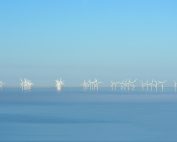
Germany’s Federal Maritime and Hydrographic Agency (BSH) has published the preliminary draft of the next Site Development Plan (Flächenentwicklungsplan, FEP), which sets out how the country intends to reach 70 GW of offshore wind capacity by 2045. The German Offshore Wind Energy Association (BWO) welcomed the draft but said the ongoing amendment of the Offshore Wind Energy Act (WindSeeG) must now create the conditions for investment.
Fourteen sites are to be newly defined in the update: four in area N-14 (N-14.1 to N-14.4), eight in area N-16 (N-16.1 to N-16.8), plus N-6.9 and N-12.7. Each covers roughly 1 GW. The draft shows a further 13 sites as an outlook, which are not expected to be fixed in this procedure, and the BSH is to carry out central pre-investigation of additional areas. BWO said smaller sites and central pre-investigation open tenders to more bidders, strengthening competition and lowering planning risk.
For new sites in zones 4 and 5, the draft assumes an average corrected power density of 7.3 MW per square kilometre. That is below the ceiling of 8 MW/km² that BWO had called for, and the association says lower density reduces wake effects between turbines and raises output.
BWO opposes a flat default of 10% overplanting, where a wind farm’s installed capacity exceeds the capacity of its grid connection. Overplanting can improve grid utilisation but raises investment costs and, at high load, leads to more curtailed power. A Frontier Economics study commissioned by BWO and the energy industry association BDEW puts the economic optimum at between 5% and 10%, depending on the site.
“Now the political framework has to be right so that site planning turns into concrete investment. For that we need indexed two-sided contracts for difference for all future offshore wind tenders instead of a two-stage model,” said Stefan Thimm, Managing Director of BWO.
The draft also counts cross-border offshore projects towards the German target. BWO said cooperation with Denmark should come first, citing a joint study with BDEW which found that lower power density in German waters, combined with connecting wind farms in neighbouring countries, delivers higher yields and lower costs per kilowatt-hour. For the Baltic region, the Danish link is the part of the plan to watch, since Germany and Denmark share maritime borders in both seas.
BWO also asked for grid connections to remain available until wind farms are fully decommissioned, with dismantling and new-build plans coordinated early. The consultation runs until early December. Until the plan is finally adopted, the FEP 2025 in its latest amended form remains in force.