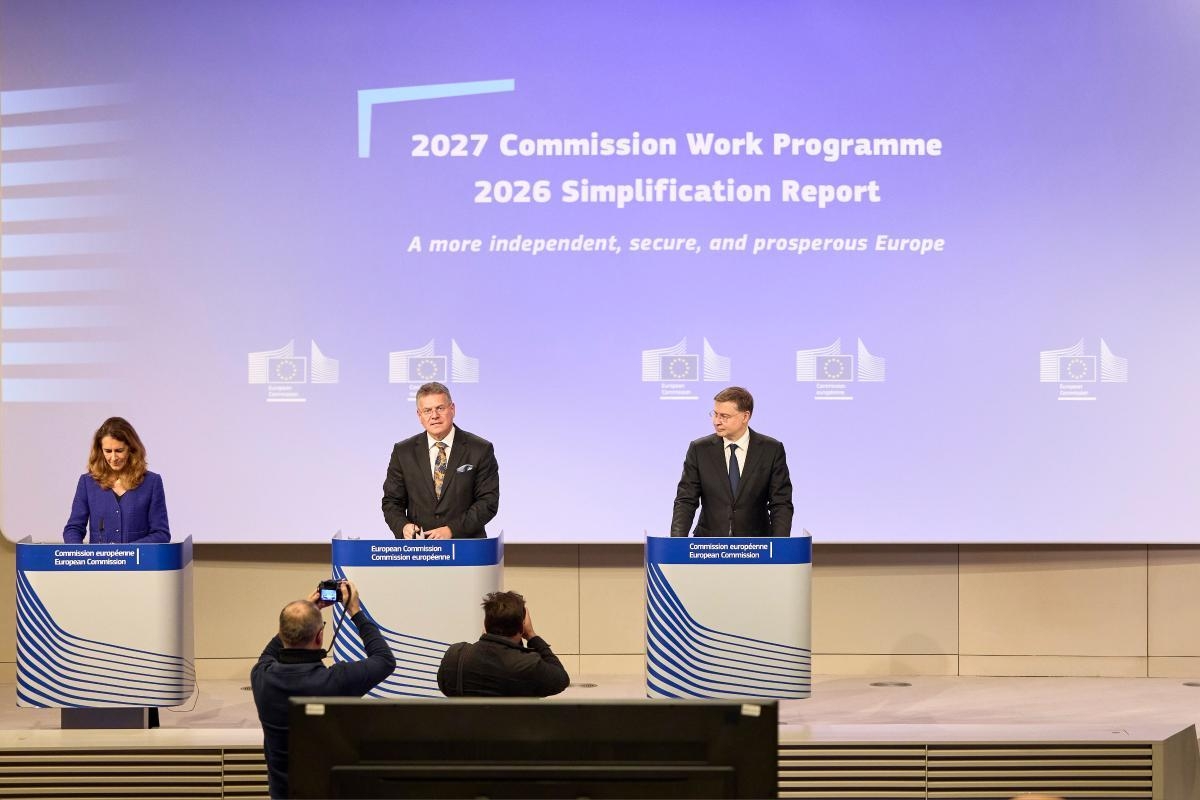
The European Commission adopted its 2027 work programme on 4 November 2026, setting out the main legislative and non-legislative initiatives for the coming year. It was published together with the 2026 annual overview report on simplification, implementation and enforcement. President Ursula von der Leyen said the programme is meant to equip Europe for the challenges ahead, from deepening the Single Market to expanding global partnerships.
On energy and competitiveness, the Commission says it will take coordinated action to address high energy prices and further remove barriers to the Single Market. It plans a European Corporation on Critical Raw Materials, proposals to complete the Savings and Investments Union, and a digital transformation package. The programme also refers to a post-2030 framework that is to deliver simplification while meeting decarbonisation objectives, and to a review of the CO2 standards for heavy-duty vehicles to move away from fossil fuels.
On defence and security, the Commission will continue investing in defence and supporting Ukraine, including through the EU-Ukraine Defence Industrial Pact. New instruments include a European Instrument for Strategic Enablers and a European Security Emergency Protocol to enable a faster EU response to security threats. The Commission also plans a European emergency response framework to protect the external border. In its foreign-policy section it points to freedom of navigation and maritime security through the straits of Hormuz and Bab al-Mandab.
The annual report records the pace of enforcement: the Commission launched 874 infringement procedures, the highest number in ten years, referred 61 cases to the Court of Justice and requested financial sanctions in 25 cases. It closed 499 procedures after member states complied. Since the start of its mandate the Commission has proposed 12 omnibus packages, which it says could generate more than EUR 22 billion in annual savings, nearly 60% of its mandate target. It is also working with member states on a pact against gold-plating, and says it will pursue faster permitting in 2027.
The Commission called on the co-legislators to reach a political agreement on the 2028–2034 Multiannual Financial Framework by the end of the year, so that implementation can start on 1 January 2028. Further detail on individual proposals is set out in the work programme and its annexes, which the Commission has published on its website.