Listen to the interview (14 min)
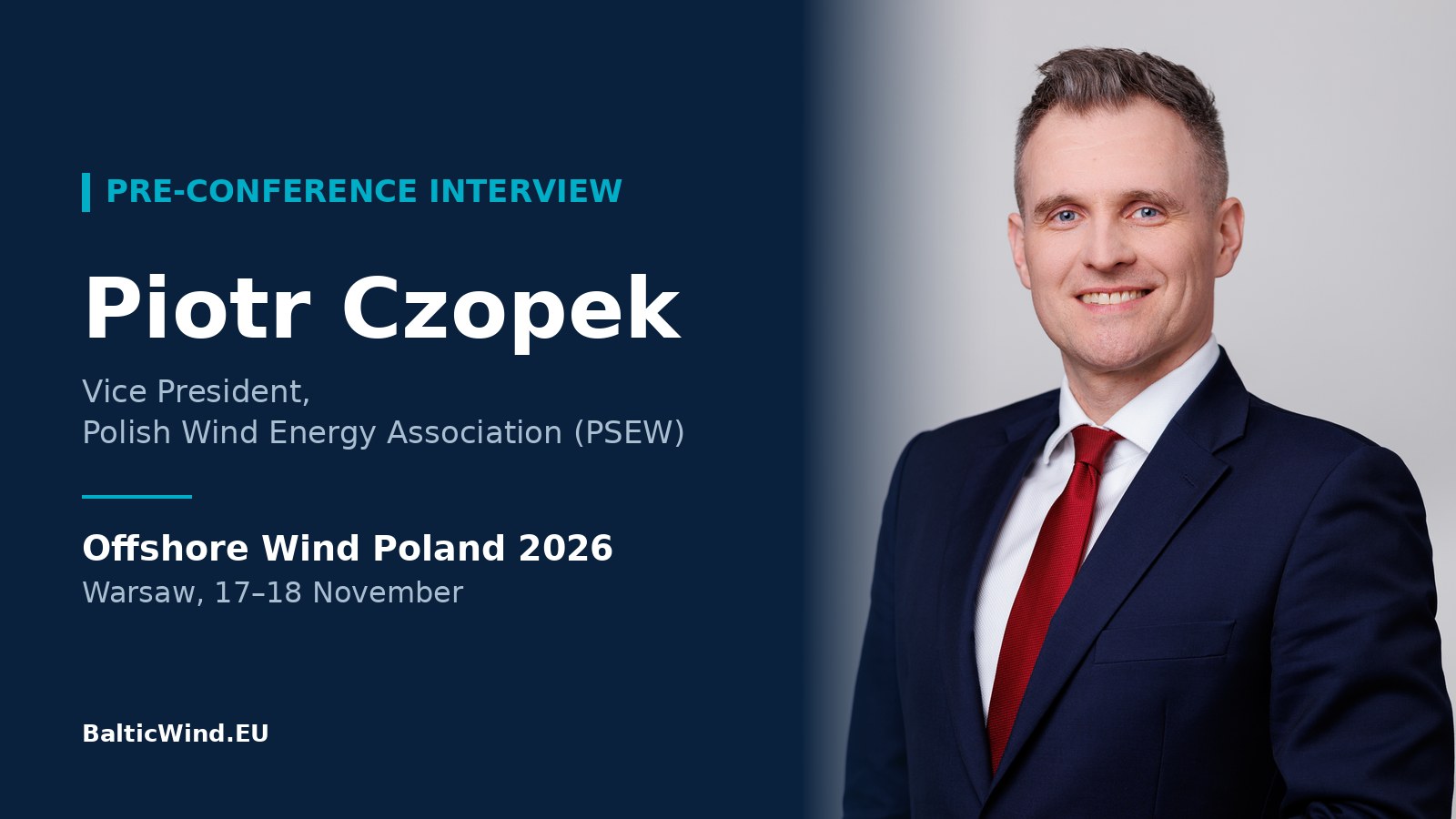
On 17–18 November, Warsaw hosts Offshore Wind Poland, the largest offshore wind conference in the Baltic Sea region. This year’s edition comes as the first electricity from Polish offshore wind farms is already flowing into the national grid.
Krzysztof Bulski spoke with Piotr Czopek, Vice President of the Polish Wind Energy Association (PSEW), which organises the conference, about why the event has turned regional, how the Baltic can close its gap to the 2030 targets, and what “local content” should mean for foreign suppliers.
This interview was recorded for the Baltic Perspective podcast. It has been edited for length and clarity.
Offshore Wind Poland started as a conference about the Polish market. Today it is a regional event. How has PSEW’s approach changed?
At first we focused on the Polish market and on developing the first projects in the Polish part of the Baltic Sea. Now we see that if we want to deliver all those gigawatts on the Baltic, we need to cooperate around the whole sea.
That cooperation includes not only the eight Baltic Sea countries, but also Norway, which is not directly on the Baltic but is strongly committed to the region. Those nine countries need to work together to deliver the numbers set out in many documents at EU level and beyond.
That is why we dedicated a separate part of the conference, the Baltic Offshore Strategy Summit, strictly to cooperation between the Baltic Sea countries on bringing more gigawatts to the Baltic.
A recent regional report expects the Baltic Sea to reach about 9.5 GW by 2030. That is less than half of the 19.6 GW set in the Marienborg Declaration. Poland is on track for its share, but there is a gap. How can it be closed?
Over the past years we have seen that political declarations are one thing, and delivery is another. Delivery comes from business, with strong support from governments. But there is a need for stronger cooperation and a bottom-up approach.
That is why we decided to move forward together with our member companies, and together with Orlen, which started its own cooperation initiative at its Baltic Energy Conference on 3 September. We see our conference as an extension of that work. The more of us there are, the stronger we are. By discussing within the industry how to deliver, and setting additional targets on how to get there, we can do what political statements alone cannot.
Local content has been an industry topic for years, but only recently has the Polish government made it part of its political narrative. Pledges are turning into purchase orders. Where are the openings for foreign companies in the supply chain, with or without a Polish partner?
PSEW started the discussion about local content many years ago, five to seven years back, when the offshore wind targets and regulation were being prepared. It is very good that the government is now putting the topic high on the agenda.
Last year, together with Wind Industry Hub, we prepared a proposal for an offshore wind industry strategy. There has been no movement on adopting such a strategy at government level, but some actions are being taken, and that is good.
What we also stress is that local content should mean European or regional content. No single country will deliver on its own or withstand competition from Asian manufacturers. If we want to build capacity in Europe, we need to cooperate regionally and across the continent.
This matters not only as a driver for national and European economies, but also for security of supply. The Polish market is sizeable, around 18 GW. But the European market is around 300 GW. While developing on the Polish market, our industry can also supply equipment and services to that much broader pipeline of projects. That is why cooperation is needed.
WindEurope is lobbying in Brussels for better support for an EU-origin supply chain, and in Brussels a group of countries is always heard better than one. How big is the opportunity for the industry to find one voice at Offshore Wind Poland?
It is essential. Look at the North Sea: close cooperation between companies, governments and other stakeholders helped those countries get where they are today. The Baltic needs the same.
In Poland we are delivering what we planned, and that is a strong signal to the market. Other markets are in a different situation. Poland can be an example of how to deliver projects in the Baltic, and we want to show how we did it and encourage others to move at the same pace or faster. A broader pipeline of projects is also what our industry needs to grow.
During the summit we will discuss how to deliver common projects, and even how to sequence them across the region. We want to avoid years without any construction followed by a rush of it, because that costs more than a stable pace of development.
Security is now high on the regional agenda as well.
Yes, one of the main panels of the summit is dedicated to the security and safety of offshore critical infrastructure. We see how many new threats have emerged in the Baltic since Russia’s aggression against Ukraine. We need to be resilient to them, and that requires cooperation.
The Baltic is a relatively small basin, but it is still a huge area to patrol and protect. We need to understand the threats and agree how to tackle them. Rules need to be set, and developers and navies need to work together to bring security to the Baltic Sea.
For a long time, when Poland talked about “the region”, it looked south. Offshore wind showed how strong our partners around the Baltic are, and now security is proving how essential that collaboration is. Beyond the industry, there are ports, local communities and the workforce. How can this platform develop in the future?
The Baltic region has historically been close to Poland, and this cooperation already has a long history. More importantly, all the countries around the Baltic are industrialised countries with strong economies. We should build on that experience and strengthen it.
During the summit, PSEW, Wind Industry Hub and similar organisations from across the region will sign a Memorandum of Understanding on creating a regional strategy for the offshore wind industry. The aim is to tighten our ties and deliver the targets from the industry’s side.
I think this is an important step towards closing the gap you mentioned. Poland is on track, but other countries are lagging behind on their Baltic offshore targets. To deliver them, we need a strong industrial base, and I expect we can build it quite fast, working together with associations like ours from across the region. It will also be a good driver for cooperation in other fields.
Is it still possible to register?
Of course. Everyone is welcome, and we especially encourage people from across the Baltic Sea region to take part in the activities I mentioned.
Offshore Wind Poland takes place in Warsaw on 17–18 November 2026. Krzysztof Bulski will moderate the conference panel on offshore infrastructure security.