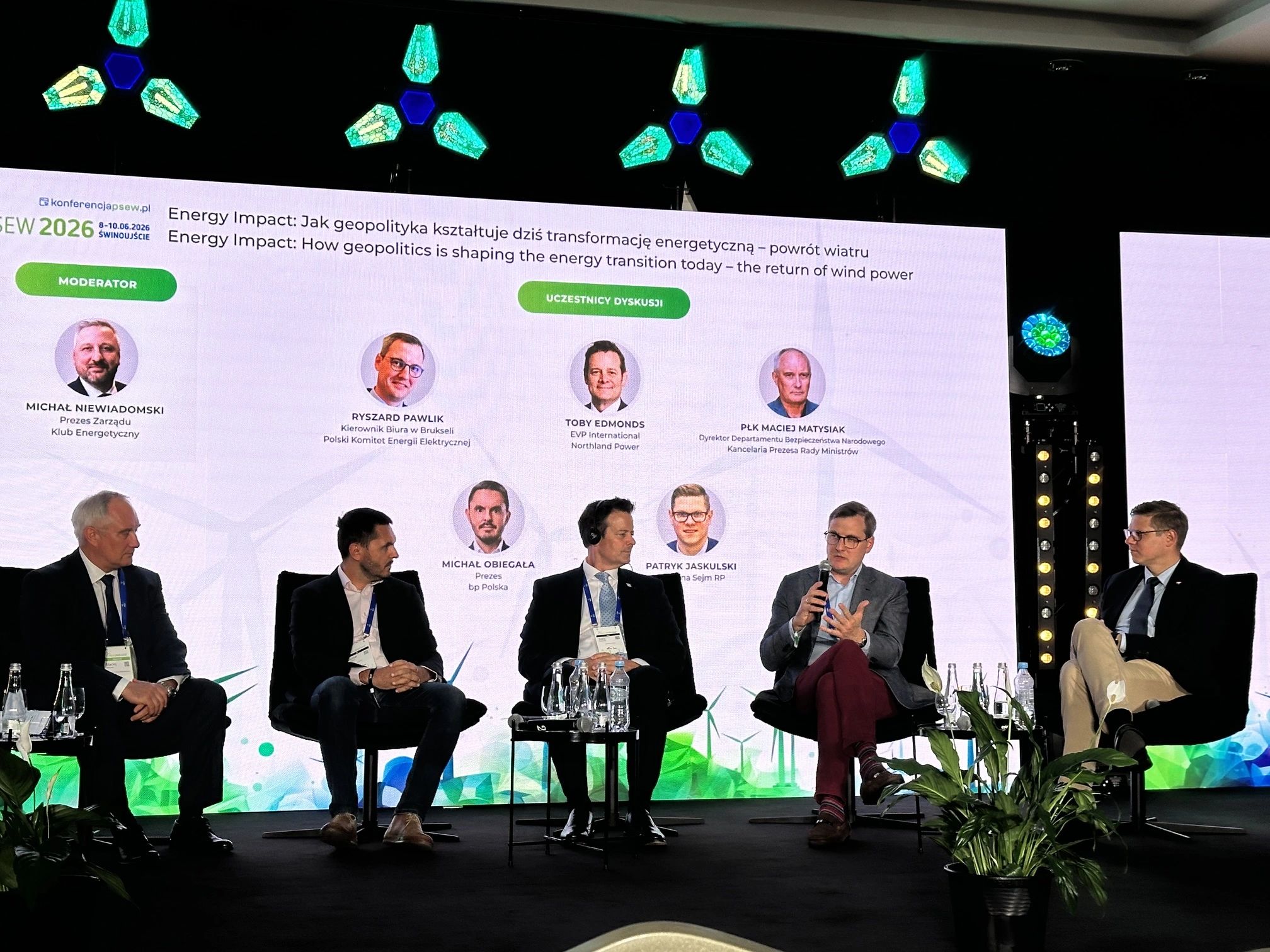
The European Union is like an overweight patient diagnosed with a serious illness and told to exercise, but unable to follow the prescription: running strains an ageing heart and joints, there are no cycle paths where the patient lives, and the ideal option, swimming, means a pool 50 kilometres away and no car to reach it. Four years on, the patient collapses again. That, in energy terms, is the EU, argued Ryszard Pawlik, Head of the PKEE Brussels Office, recounting his remarks from the panel “Energy Impact: how geopolitics shapes today’s energy transition” at PSEW 2026 in Świnoujście, where he appeared alongside Paweł Wróbel for PKEE Brussels.
Since Russia’s full-scale invasion of Ukraine, Pawlik said, the EU has been acutely aware of two costs: dependence on imported fuels, above all oil and gas, and energy prices well above those of global competitors led by the United States and China. The bloc has not been idle, he noted, pointing to the REPowerEU strategy and the legally enshrined ban on buying Russian gas. But the past four years, and what he described as a fresh crisis triggered by a US-Israeli strike on Iran, have exposed how complex the challenge is, with geopolitical, infrastructural, economic, political and social constraints layering on top of one another.
The familiar “energy transition triangle” of security, competitiveness and climate has, in his view, given way to a pentagon. Two further corners now carry equal weight: affordable energy prices for all consumers, a theme gaining political traction across a growing number of member states, and economic and technological resilience. These goals are not mutually contradictory, he said, but neither are they fully complementary.
Asked how to treat the “patient” effectively, Pawlik stressed two priorities. The first is electrification pursued in a smart, cost-effective way, where the build-out of clean generation is matched by a proportional expansion of storage and grids, especially distribution networks, alongside adequate system flexibility and the potential of sector coupling across industry, transport and heating. The second is technology neutrality and diversification of sources, technologies and suppliers. The old proverb warns against keeping all your eggs in one basket, he added, and a healthy, balanced diet means not filling that basket with eggs alone.
For the Baltic Sea region, the framing lands close to home. Świnoujście sits at the centre of Poland’s offshore wind and LNG build-out, and the constraints Pawlik described, grid bottlenecks, price pressure and the search for supply security, are precisely the ones shaping investment decisions around the southern Baltic. He thanked fellow panellists and PSEW’s Janusz Gajowiecki for the invitation, and signalled he expects to return next year.