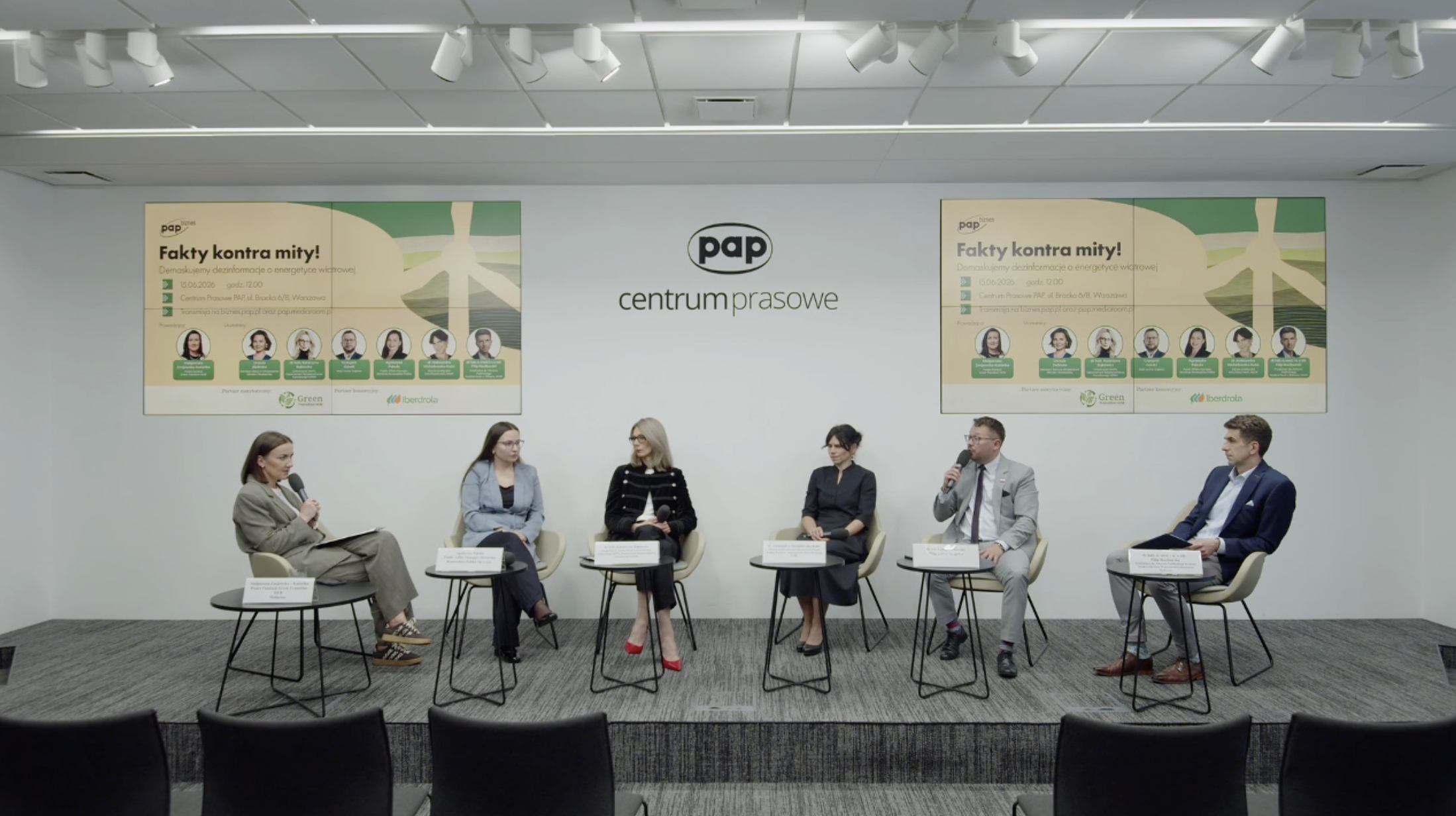
A press conference in Warsaw, ‘Facts and Myths: Debunking Disinformation about Wind Energy’, brought together ministers, security analysts, scientists, an investor and a local mayor to confront the most common myths about wind power and the disinformation behind them. The debate was moderated by Malgorzata Zmijewska-Kukielka, president of the Green Transition Hub foundation.
Climate and Environment Secretary of State Urszula Zielinska set the frame, arguing that energy disinformation is a deliberate, funded operation and a matter of state security. She cited close to 70,000 disinformation publications about energy in Polish media between 2022 and 2025, more than 1.2bn audience contacts, and a Russian cognitive-warfare effort she put at USD 2-4bn a year, aimed at keeping Europe dependent on imported fossil fuels.
Disinformation expert Katarzyna Bakowicz presented a study carried out with the Polish Wind Energy Association (PSEW): 70 per cent of surveyed wind firms reported disinformation attacks and a real impact on project schedules or costs, and one in four reported physical violence. Her wider thesis was that disinformation is a consequence of decades of neglected civic and media education, with Finland offered as proof that resilience can be built. Aleksandra Michalowska-Kubs of the National Research Institute (NASK) noted that the narratives have barely changed in 20 years — noise, health, birds, falling land values — and urged citizens not to share content they are unsure of, to check sources and to report disinformation.
From the industry, Iberdrola’s Agnieszka Pakula said developers now run education campaigns long before any formal procedure, but residents engage with the facts only once they hear about concrete local benefits. Grajewo mayor Grzegorz Gorski offered a working counter-example: 19 turbines since 2021, about PLN 3.2m a year in municipal taxes, and trust built by attributing tangible improvements — schools, kitchens, trips — openly to the wind farms. Public-health researcher Filip Raciborski explained why health scares are so effective, working by sowing doubt rather than changing minds, and warned there is no quick fix.
The recurring conclusion was that countering disinformation is slow, local work — trusted messengers, real experience and patient, fact-based communication, alongside regulation of the large technology platforms. As one quoted line had it, the answer to a farm of trolls is a farm of elves, and everyone can be one. The moderator’s foundation recently co-produced, with Polityka Insight, a ‘Balance sheet for municipalities’ report gathering the local benefits of wind power across more than 30 Polish municipalities.