An artificial-intelligence study has individually assessed every residential rooftop in Germany — more than 28 million buildings across all 401 districts — and concluded the country is leaving around €45 billion in annual household electricity savings unrealised. The German Rooftop Valuation Report was published on 23 June in Munich at the opening of Intersolar Europe.
Despite that potential, only 4.1 million German homes currently have a solar installation. The study puts the average household’s savings at about €1,620 a year on an investment of €12,167, with a payback period of roughly 8.4 years and a 20-year return of €19,030. Across all analysed roofs, the estimated 20-year return totals €533.7 billion. The figures assume a 10.34 kWp system paired with a 9.6 kWh battery and exclude government subsidies.
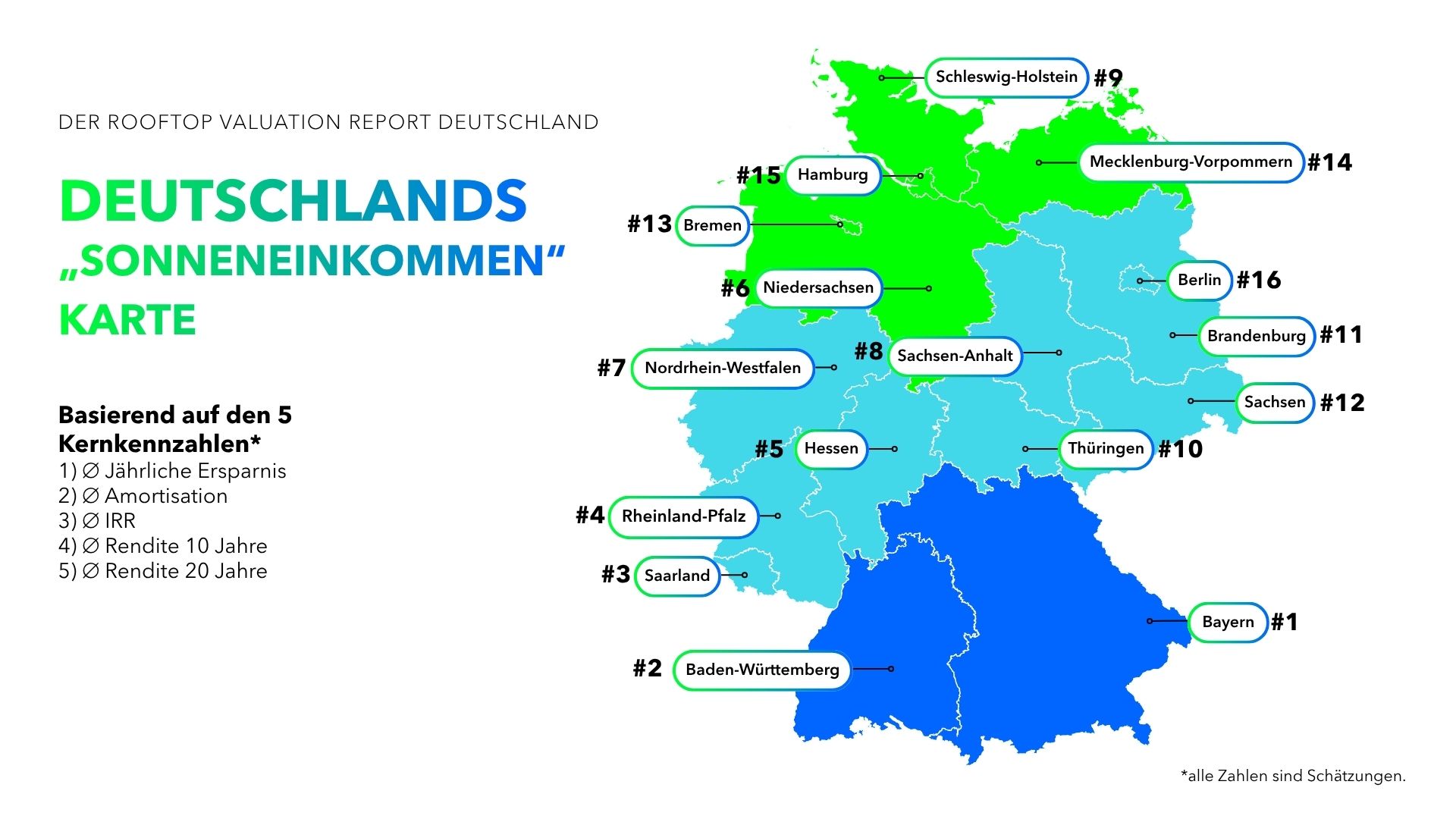
The report finds a pronounced north-south divide. Bavaria leads on every metric, with average annual savings of €1,696 and a 20-year return of €20,504 per household; the district of Kempten in the Allgäu records the highest return of all at €21,719. Berlin ranks last, at €1,388 a year and a €14,555 return — close to €6,000 below Bavaria — a gap the authors attribute mainly to Bavaria’s rural building stock against Berlin’s dense urban housing. Even so, the study reports positive returns everywhere.
The findings land as Germany’s residential solar market loses momentum. Installations of home rooftop systems fell 21% in the first quarter of 2026, according to industry body BSW Solar, even as the country aims for 215 GW of solar capacity by 2030. A draft of the 2027 Renewable Energy Act (EEG) would scrap fixed feed-in tariffs for new systems under 25 kW and cap feed-in from smaller systems at 50% of installed capacity — changes that would make battery storage close to essential for a system to pay for itself.
The analysis was built from satellite imagery, AI-driven 3D building reconstruction and geographic information systems, reconstructing more than 87% of buildings as 3D models to estimate roof pitch, orientation and shading at address level rather than by statistical extrapolation. It was produced by GreenSketch, a solar-design platform owned by Australia’s OSW Group, with partners GoodWe and LONGi Solar. For Germany — the largest electricity market on the Baltic and a pivotal player in the region’s energy transition — the data underline how much of the residential solar opportunity remains untapped even as policy support narrows.