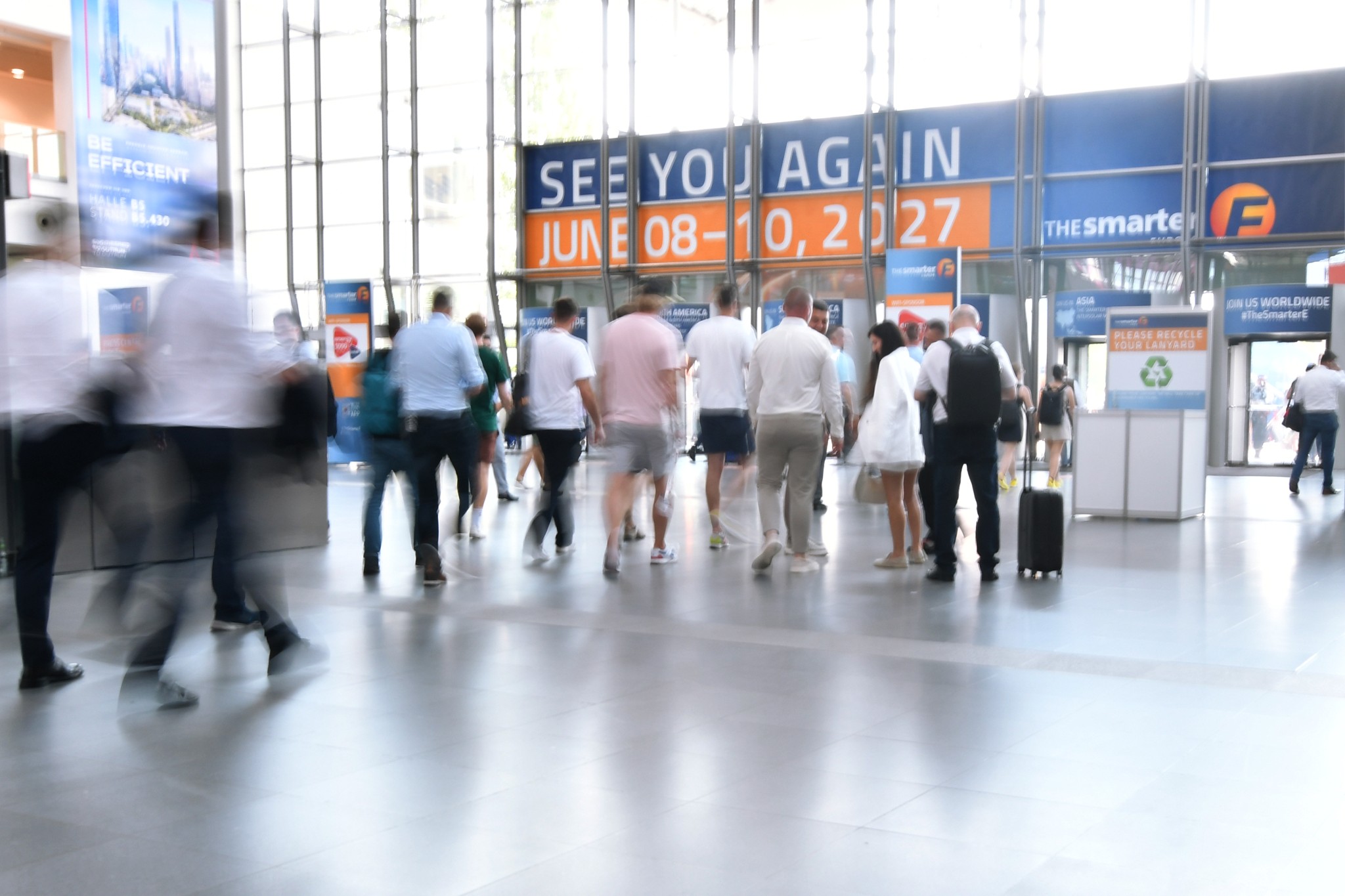
The smarter E Europe 2026 ended on 25 June after three days at Messe München, with organisers reporting 2,650 exhibitors from 52 countries and around 105,000 trade visitors from 163 countries. More than 66 percent of exhibitors came from outside Germany.
The fair brings together four parallel exhibitions — Intersolar Europe, ees Europe, Power2Drive Europe and EM-Power Europe — covering solar power, battery storage, electric mobility and energy management. Four specialist conferences held on 22 and 23 June, ahead of the main exhibition, drew more than 3,000 participants. This year’s central theme, “Renewables 24/7”, focused on how solar, wind, storage and smart grid technologies can supply power reliably around the clock.
A special exhibit of the same name set out how a future energy system could become more electric, decentralised, digital and flexible, with buildings and electric vehicles shifting from passive consumers to active participants. “Only if we store, manage and use electricity intelligently — exactly when it is cheap and green — can we build an energy system that is affordable for customers and good for the grid,” said Bastian Gierull, chief executive of Octopus Energy Germany.
Markus Elsässer, founder and managing director of organiser Solar Promotion, said fossil energy was “a phase-out model” and argued that renewables had demonstrated reliability, resilience and efficiency. Germany already generates around 60 percent of its electricity from renewable sources, while spending some 80 billion euros a year on fossil fuel imports.
The event also drew political attention. Rita Schwarzelühr-Sutter, parliamentary state secretary at the federal environment ministry, told delegates that the energy transition now concerned around 440,000 jobs, economic resilience and national security, not climate protection alone. For the Baltic Sea region, where Germany, Poland and the Nordic states are scaling up offshore wind and grid links, the technologies on show point to how round-the-clock renewable supply might be managed in practice. The next edition is scheduled for 8–10 June 2027 in Munich.