Berlin, April 14, 2026 –Offshore-Wind is an industrial growth driver in GermanyThe industry creates jobs throughout Germany. 31.530 full-time positions (around 49.000 employment relationships) and €14,6 billion in gross value added in 2025. This is shown in a study by wind:research Commissioned by the German Offshore Wind Energy Association (BWO). The industrial inland regions – such as North Rhine-Westphalia, Baden-Württemberg and Saarland – benefit particularly strongly. If the expansion target of 70 gigawatts by 2045 is achieved, the industry can expect around 120.000 employees and over 50 billion euros in added value. grown.
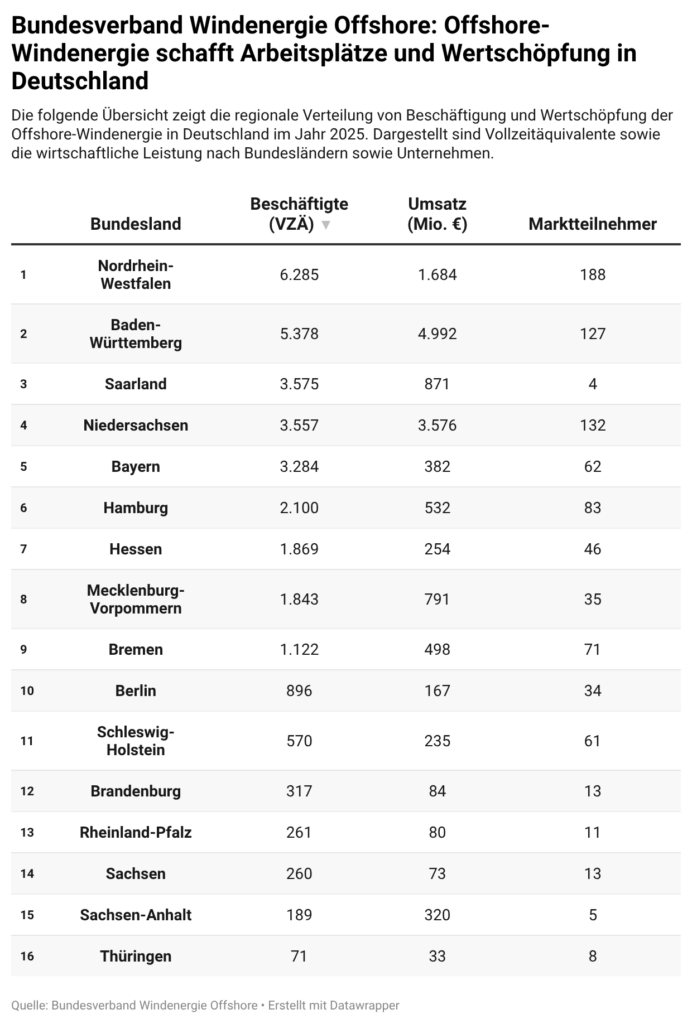
The study analyzes the economic significance of the offshore wind industry along the entire value chain and clearly demonstrates that offshore wind energy is a nationwide job engine. With approximately 6.300 full-time positions, North Rhine-Westphalia accounts for the largest share of employment, followed by Baden-Württemberg with over 5.300, and Saarland and Lower Saxony with more than 3.500 full-time positions each. A significant portion of the industrial value creation takes place inland, while Northern Germany remains a hub for implementation, logistics, and operations.
The 31.530 full-time equivalents in the sector represent the actual employment volume, independent of part-time rates. The potential is considerable: with stable growth trajectories, employment could almost quadruple by 2045.
Value creation under pressure – infrastructure becomes a bottleneck
With €14,6 billion in added value in 2025, offshore wind energy remains a significant economic factor. Baden-Württemberg plays a leading role with around €5 billion, followed by Lower Saxony and North Rhine-Westphalia. This added value is generated along all project phases of offshore wind farms – from planning and construction to operation.
At the same time, the study reveals a critical development: The national supply chain is facing increasing international competitive pressure. Grid connectivity remains a key bottleneck for the industry. As a result, market participants expect project delays averaging 3,2 years – with corresponding consequences for projects and the supply chain. A total of 893 market participants are active in Germany, around a third of whom operate exclusively in the offshore wind energy sector.
Fewer offshore wind kostet 50.000 Jobs
Model calculations in the study show what will happen if the legally mandated expansion target of 70 gigawatts of offshore wind energy by 2045 is not met. Lowering the expansion targets would have significant economic consequences: a reduction to 60 gigawatts by 2045 would mean Germany foregoing up to 50.000 additional jobs and around 20 billion euros in added value.
“The study provides reliable figures on the importance of offshore wind energy for Germany. With €14,6 billion in gross value added, around 49.000 jobs and over 31.000 full-time positions, offshore wind has long been a core industrial sector, extending far beyond the coastal regions,” says Stefan Thimm, Managing Director of the BWO.
“Anyone who questions the expansion of offshore wind energy not only jeopardizes the energy supply, but also tens of thousands of jobs and industrial prospects in Germany. Lowering the expansion targets would weaken the value chain and shift investments abroad.”
“What’s crucial now are reliable framework conditions: stable expansion pathways, investments in grid connections and port infrastructure, and a coordinated industrial policy strategy to strengthen value creation. Only in this way can the industry realize its potential and grow to up to 120.000 employees by 2045.”
Background to the study
The study was conducted by the institute wind:research Prepared on behalf of the BWO. Based on an online survey of companies, expert interviews and a market analysis. It was financed by companies in the industry: August Friedberg GmbH, Brück GmbH, EEW Group, Eisenbau Krämer GmbH, ITH Schraubtechnik, JBO Engineering Group GmbH, Ramboll Deutschland GmbH, Robert Krebs GmbH, RODOPI Holding GmbH, Salzgitter AG, Schmidbauer GmbH & Co. KG, SHS – Stahl-Holding-Saar GmbH & Co. KGaA, Steelwind Nordenham GmbH, Venjakob Maschinenbau GmbH & Co. KG, Westfälische Drahtindustrie GmbH.