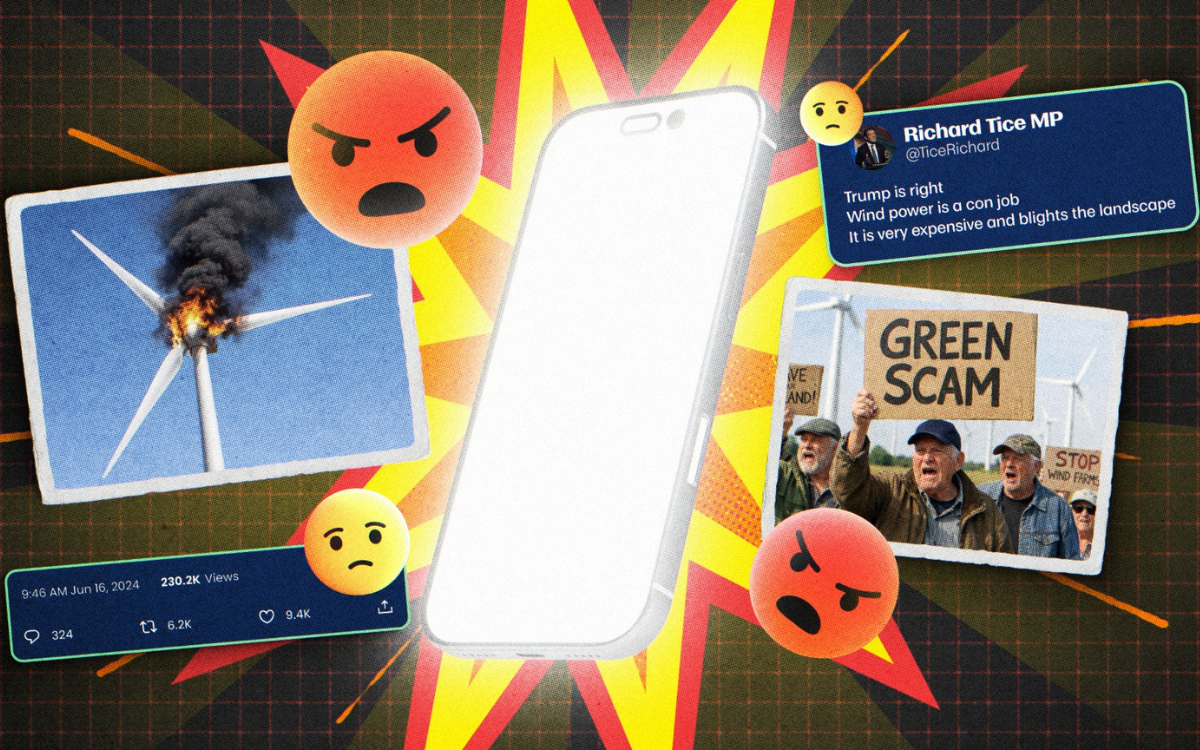
Last month, a comprehensive report released by WindEurope and CASM Technology shed light on a growing systemic risk: the weaponization of dis- and misinformation against the European wind industry. Titled Wind Energy Dis- and Misinformation: Undermining Europe’s Security and Competitiveness, the study details how a professionalized ecosystem of actors is distorting public debate to delay the deployment of homegrown, affordable energy at a time when the continent’s security is most vulnerable.
The Digital Arsenal: 43,000 Posts and Millions of Views
The social media investigation, which tracked activity from May 2024 through February 2026, mapped a network of 573 accounts across platforms like Facebook, X, TikTok, and YouTube. This relatively small network produced 42,947 anti-wind posts, generating 6.3 million active engagements and reaching tens of millions of viewers.
The report identifies a clear division of labor within this ecosystem:
-
Anti-Wind Groups: These organizations dominate by volume, producing 78% of all posts and providing the movement’s infrastructure.
-
Politicians and Political Parties: While accounting for only 2% of the content, they serve as the primary amplifiers, generating 16% of total engagement and pushing narratives into the mainstream.
-
Activists and Fringe Media: Accounts like “Wide Awake Media” (UK) and “Motvind Norge” (Norway) act as central nodes, with Wide Awake Media alone capturing 11% of all audience engagement from fewer than 100 posts.
Strategic Distortion: The Four Core Myths
The content analyzed is not merely random criticism; 68% of the dataset consists of specific dis- and misinformation-related narratives. These claims are designed to erode public trust by centering on four recurring themes:
-
Hidden Interests and Fraud: Portraying developers as greedy elites imposing their will on local populations.
-
Environmental Destruction: Claims that turbines have a profound net negative impact on nature, despite evidence to the contrary.
-
Technological Unviability: Depicting wind power as a driver of blackouts and grid instability.
-
Economic Failure: Framing wind projects as nonsensical defiance of market logic.
Real-World Fallout: From Moratoriums to Masked Raids
The consequences of this information war are tangible and costly. Across Europe, wind energy projects worth billions of euros have been delayed or cancelled following campaigns built on exaggerated or false claims.
In Bulgaria, the municipality of Vetrino became the first in Europe to impose a blanket moratorium on wind energy. The campaign was fueled by claims that turbines cause cancer or agricultural collapse, effectively blocking a €1.2 billion onshore project. Similarly, in Austria, the far-right FPÖ helped secure a referendum in Carinthia that prohibited wind construction on 99.93% of the territory, jeopardizing €600 million in investments.
Beyond the halls of government, the rhetoric has escalated into physical violence:
-
Italy: In Tuscany, approximately 50 masked individuals, some armed with knives, stormed a wind farm construction site in July 2025, threatening workers and vandalizing machinery.
-
Sardinia: Perpetrators unscrewed bolts fixing a turbine to its base, creating a serious risk of collapse that was only discovered by chance during maintenance.
-
The Netherlands: Pro-wind politicians were depicted in Nazi-style posters, and farmers hosting turbines saw their barns and hay bales set on fire.
The Shadow of Foreign Interference
The report suggests that these domestic anti-wind movements are often supported by external interests seeking to maintain Europe’s dependence on imported fossil fuels. NATO has identified the Kremlin as a main driver of conversations harming green energy on social media, using it as a tool to reduce Europe’s energy independence. Polish counterintelligence estimates that Russia and Belarus spend between $2 billion and $4 billion annually on influencing public discourse, with a significant portion targeting green energy policies.
Furthermore, a study by Brown University found that anti-offshore wind networks in the United States—whose content circulates widely in Europe—received over $72 million from fossil fuel and “dark money” donors between 2017 and 2021.
A Call for Fact-Based Resilience
The economic stakes are immense. Failing to deliver a renewables-based energy system would cost Europeans an estimated €1.6 trillion more than achieving net-zero targets. Currently, every day of delay costs European taxpayers roughly €500 million in extra energy import costs during price surges.
WindEurope provides three core recommendations to address this crisis:
-
Platform Accountability: The EU and Member States must ensure social media platforms take responsibility for the scale at which misinformation spreads.
-
Acting on the Mandate: Policymakers must lead decisively, noting that 88% of EU citizens support action to increase renewable energy.
-
Media Literacy: Investing in digital education from an early age is essential to help citizens recognize manipulation and distinguish reliable information from -related myths or technical falsehoods.
As WindEurope CEO Tinne Van der Straeten notes, “Confronting dis- and misinformation is about safeguarding Europe’s ability to shape its own destiny”.